Burial Costs in Indiana (2026)
Three figures set the cost of an Indiana burial in 2026: about $6,900 for the funeral service, about $3,200 for the cemetery plot, and $500 to $5,000 for a headstone. With the vault, the casket and opening and closing the grave, our estimate for the whole burial is $15,550 to $20,050. Below are the item prices, Indiana's rules on vaults and funeral directors, and the state help for Medicaid recipients.
Indiana Burial Prices, Charge by Charge
| Cost | Indiana average | Typical spread |
|---|---|---|
| Funeral service | $6,900 | $5,175 – $8,970 |
| Cemetery plot | $3,200 | $1,600 – $6,400 |
| Casket | $2,070 | $690 – $5,520 |
| Burial vault / liner | $1,280 | $800 – $10,000 |
| Opening & closing grave | $1,600 | $500 – $3,000 |
| Headstone / marker | $1,500 | $500 – $5,000+ |
| Embalming | $690 | $500 – $1,500 |
A note on the Indiana estimates: we modelled these prices rather than surveying Indiana funeral homes and cemeteries, so they are not a quote or professional advice. You can check our method and read the disclaimer.
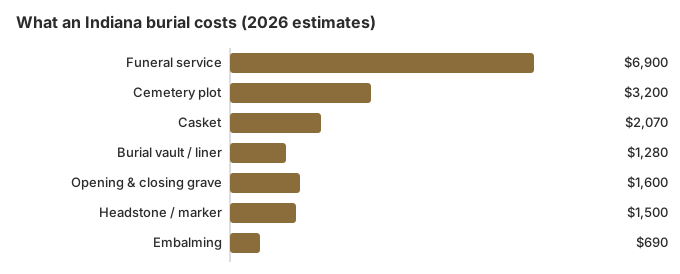
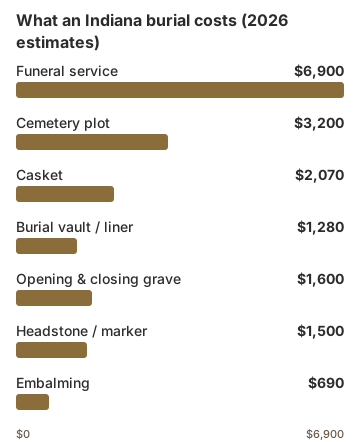
For the complete burial, with every cemetery charge, Indiana families usually pay $15,550 to $20,050; the choices you make decide where in that range you land.
Kinds of Burial in Indiana
Saving Money on an Indiana Burial
Practical ways to spend less in Indiana:
- Check smaller cemeteries. Township, county and fraternal cemeteries in Indiana are often missing from online searches, and the county clerk's office can point you to them.
- Call independent homes too. Family-owned funeral homes remain common in Indiana and often price closer to the NFDA national averages than homes owned by national chains.
- Ask about immediate burial. Direct burial, with no viewing or service before the interment, keeps the funeral home's charges to a minimum.
Pricing an Indiana Burial by Phone
Going through the General Price List by phone with two or three Indiana funeral homes usually shows where their prices sit and which packages carry a markup. The FTC Funeral Rule requires them to give prices over the phone, so it costs nothing but time.
Burial Resources
- Green Burial OptionsEco-friendly and natural alternatives
- Headstone & Monument GuideCosts, types, and buying tips
- Best Burial InsuranceCompare plans to cover burial expenses
- Best Online Casket RetailersCaskets bought online often cost less
- Funeral Consumers AllianceNonprofit consumer advocacy for funeral pricing
Compare Funeral Costs
- Cremation vs. Burial Cost ComparisonSide-by-side price comparison to help you decide
- How to Compare Funeral PricesStep-by-step guide to comparing funeral prices
- Cheapest Funeral OptionsLower-cost alternatives, with typical price ranges
- Funeral Cost BreakdownEvery line item explained: know what you're paying for
- Direct Cremation: Most Affordable OptionNFDA 2023 median $2,645 with a family-supplied container (latest available)
- Average Funeral Cost in 2026National cost breakdown with real prices
Certified Copies for an Indiana Burial and Estate
Before a cemetery will transfer a plot, and before a probate, insurance or bank claim can move, each office usually wants its own certified death certificate. Indiana's state fee is $8 for the first copy and $4 for each additional copy of the same record ordered at the same time, and those fees are not refunded (Indiana Department of Health, Order Certificates; checked November 12, 2026). The state office does not take walk-in customers. The department recommends the local health department where the death occurred for faster service; its own mail orders are listed at 60 days.
- Order from the local health department when you can; it is usually quicker than a state mail request.
- Count the offices that will want an original, and get the $4 extras in the same order.
- The $8 state fee is a search-and-copy charge, not a reason to overpay a funeral home's add-on.
Indiana's Burial Permit and the Cemetery's Permanent Record
In Indiana the person in charge of the burial must get a permit for disposition from the local health officer of the county where the death happened, and must have it before the burial and before the body leaves that county. The health officer issues it once the death certificate has been properly completed (IC 16-37-3-10 and -11; checked October 29, 2026). A family that hopes to bury on its own land should ask the county or town first: the state's Division of Historic Preservation and Archaeology does not create cemeteries and sends anyone planning a family cemetery to local government, with IC 23-14 as the governing law. Once a cemetery exists on private land, the parcel it sits on can be reclassified as cemetery land and assessed at $1 an acre (IC 6-1.1-6.8), and anyone later selling that property must record the deed with CEMETERY in bold capitals at the bottom (IC 14-21-3), so the choice follows the land for good (Indiana DNR cemetery laws).
The cemetery keeps that permit for good. Indiana requires every cemetery owner to record the date the body arrived, the date of burial, the person's name and marital status and the exact plot and grave, and to file the burial permit with that record, kept permanently in the original or on microfilm or disk (IC 23-14-56-1 and -2). Moving a grave later takes a written order from the Indiana Department of Health, the cemetery owner's consent and the consent of the closest next of kin (IC 23-14-57-1).
Indiana's Licensing Agency, FSSA Help and Veterans Cemeteries
Indiana families cannot handle a burial entirely on their own. A licensed funeral director has to remove and transport the body (Ind. Code § 16-37); the cemetery then opens and closes the grave. Burial itself has no waiting period. If the family switches to cremation, Indiana requires the 48-hour wait unless a health officer waives it (IC 23-14-31-36).
Funeral homes are licensed through the Indiana Professional Licensing Agency, which can also tell you which office takes a cemetery complaint.
Help for Medicaid Recipients
Indiana FSSA help for a Medicaid recipient can pay up to $1,200 to the funeral home and up to $800 to the cemetery, and the claim must be filed within 90 days (Ind. Code § 12-14-17). (Source: Ind. Code § 12-14-17 and the Indiana FSSA Burial Assistance Program; checked November 12, 2026.) A surviving spouse or child may also claim Social Security's $255 within two years.
Veterans Graves in Marion and Elsewhere in Indiana
Eligible veterans receive a grave, opening and closing, a liner and a headstone free in a national cemetery. Indiana's choices are Marion National Cemetery (765-674-0284), Crown Hill National Cemetery Annex (317-916-5460, cremated remains only), New Albany National Cemetery (502-893-3852, cremated remains only) and the state's Indiana Veterans Memorial Cemetery (812-273-9220) (source: VA National Cemetery Administration). For a casket burial, Marion is the only national cemetery in Indiana. The Crown Hill annex is in Indianapolis, New Albany faces Louisville across the Ohio River, and the state cemetery is in Madison.
Burial at Marion National Cemetery
- Price the cemetery on its own, since the plot, opening and closing, vault or liner and marker are often sold apart from the funeral.
- Ask whether the cemetery requires an outer burial container before shopping for one.
- Send the cemetery's bill for the $800 share before the 90-day FSSA deadline.
- For a veteran, ask Marion National Cemetery what it needs; the DD214 discharge record usually comes first.
- Call 317-234-3031 if a funeral home misprices a burial.
Marion National Cemetery and other official veterans cemeteries remain the first plot to check for an eligible Indiana veteran, because the grave, opening and closing, and marker are provided at no charge. If the family still chooses a private cemetery in Indiana, the $1,032 VA plot allowance explains the separate plot or interment allowance.
Frequently Asked Questions
How much is a burial in Indiana?
Our estimate is roughly $6,900 for the funeral service and $3,200 for a plot. A vault ($1,280), opening and closing ($1,600), a casket ($2,070) and a headstone ($500-$5,000) bring a full Indiana burial to between $15,550 and $20,050.
Does Indiana require a vault?
No Indiana law calls for an outer burial container; where one is needed, the cemetery's own rules say so. Before you buy anything with the plot, get that rule in writing, including whether a cheaper liner will do and whether the vault has to be bought from the cemetery.
One board, the State Board of Funeral and Cemetery Service, oversees both funeral homes and cemeteries in Indiana. Cemeteries must also put part of every plot sale into a perpetual care fund under IC 23-14-48, either 15% of the price or 80 cents a square foot. To complain, call the Professional Licensing Agency at 317-234-3031.
What lowers the cost of an Indiana burial?
Direct burial is the cheapest burial on most Indiana price lists, because it leaves out embalming, the viewing and a funeral home ceremony. You may provide your own casket, and the FTC Funeral Rule prohibits a handling fee for it. An eligible Indiana veteran can be buried in a VA national cemetery with no charge for the plot, opening and closing, or headstone.
What is the best way to compare Indiana cemetery prices?
Expect big differences even within one Indiana city. Township, county and fraternal cemeteries often appear only in the county clerk's records, and their plots are frequently cheaper than at commercial memorial parks.
What is the full cost of an Indiana burial?
Counting everything, an Indiana burial typically runs $15,550 to $20,050: the funeral service is about $6,900, the plot $3,200, the casket $2,070, the vault $1,280, opening and closing $1,600, and the headstone $500-$5,000.
Can an Indiana family choose green burial?
Yes, at some cemeteries. A green burial section takes a biodegradable container, no embalming and no vault, and it usually costs less overall than a conventional burial. If none is near, an Indiana family can ask for a standard plot and decline embalming.