Cremation Costs in Texas (2026)
On this site’s estimates, a Texas direct cremation costs about $1,700 and a cremation with a full service about $5,800; roughly 48% of Texas deaths end in cremation. Those are statewide estimates, not a survey of Dallas, Houston, Austin, or San Antonio funeral homes, so a local General Price List is still the only firm price. Texas also writes a clock into its Health and Safety Code: no crematory may start within 48 hours of the time of death on the death certificate unless a justice of the peace, a medical examiner, or a court waives the wait in writing. The rest of this page covers the paperwork the state requires, what a Texas crematory has to do with the ashes, and the prices to compare.
If you reached this page after looking up Dallas, Houston, Austin, San Antonio, or Fort Worth, start with the $1,700 and $5,800 statewide figures above and then request itemized lists. We do not publish a separate sourced cremation price for each of those cities. One documented local fee is Travis County’s $25 medical examiner cremation approval, which covers Austin and is usually passed through at cost; veterans may be inurned without paying for the plot or marker at Dallas-Fort Worth National Cemetery or Fort Bliss National Cemetery.
A Texas Direct Cremation Typically Costs About $1,700
Direct Cremation
- The funeral home delivers the body to a Texas crematory establishment, which can hold it under refrigeration before the authorization form is signed (§ 716.0035)
- The crematory cannot insist on a casket or turn away a body that arrives without one (§ 716.151)
- The container has to be rigid, combustible, fully covering and leak-resistant, and it is cremated with the body
- Ashes come back in a labeled temporary container unless you supply an urn
- A memorial service can be held later, at any place you choose
Cremation with Service
- Visitation and a funeral with the body present, then cremation once the 48 hours have passed
- The authorization form records the date and time of any viewing or service planned before cremation (§ 716.052)
- Often uses a rental casket or a cremation casket for the service
- Usually includes a basic urn
- The closest match to a traditional Texas funeral, at about $4,100 more than direct cremation on our figures
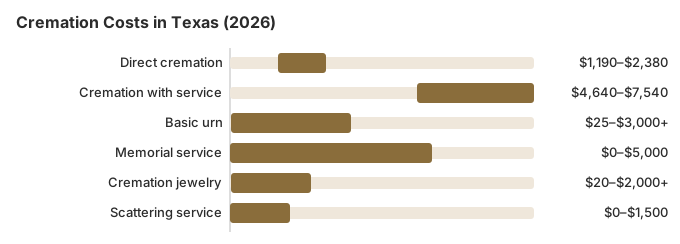
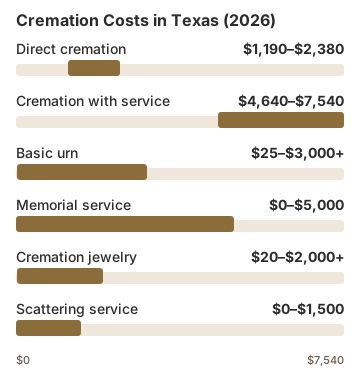
Texas Cremation Estimates, Line by Line
| Item | Average Cost | Range |
|---|---|---|
| Direct cremation | $1,700 | $1,190 – $2,380 |
| Cremation with service | $5,800 | $4,640 – $7,540 |
| Basic urn | $50 – $300 | $25 – $3,000+ |
| Memorial service | $500 – $2,000 | $0 – $5,000 |
| Cremation jewelry | $50 – $500 | $20 – $2,000+ |
| Scattering service | $200 – $600 | $0 – $1,500 |
Methodology note: These figures are our estimates, not a survey of local providers, and they are not a quote or professional advice. See how we calculate them or read the full disclaimer.
State sources: Texas Funeral Service Commission; Tex. Health & Safety Code ch. 694.
What a Texas Crematory Owes You After the Cremation
Each body is labeled on the outside of its container, and a permanent metal disc or similar marker travels with the ashes into the temporary container or urn (§ 716.103). A Texas crematory may not cremate two people in the same chamber at once unless the authorizing agent for each one agrees in writing (§ 716.153), and only crematory staff, the authorizing agent and delegates the crematory approves may be in the crematory area while the cremation runs (§ 716.152).
The ashes are released to the funeral home, to the person named on the form, or, if the form gives a shipping address, shipped no later than the 30th day after the cremation (§ 716.156). Shipping must use a method with tracking and a signed delivery receipt (§ 716.155). A temporary container has to carry a label saying it is not meant for permanent placement in a niche, crypt or grave, which is the moment to decide whether you need an urn or a cremation interment container from the cemetery.
Ashes that no one claims do not sit on a shelf forever. If the agent has not collected them or given directions, the crematory or funeral home may dispose of them from the 121st day after the cremation, and the agent is responsible for the reasonable cost of doing so (§ 716.302). The crematory keeps a record of each cremation, including where the ashes went, for at least five years (§ 716.251), which helps if a family later needs to trace them.
Once the ashes are handed over, Texas lets the authorizing agent carry them anywhere in the state without a permit (§ 716.301). The lawful resting places are a crypt, niche, grave or scattering area in a dedicated cemetery, uninhabited public land, a public waterway or the sea, or private land with the owner’s written consent (§ 716.302). If relatives disagree about the cremation or about who gets the ashes, the crematory may refuse to proceed or to release them until the dispute is settled or a court orders it (§ 716.201).
Texas Details Families Rarely Hear About
Any Texas crematory that was not already registered with the state on September 1, 2003 has to sit next to a perpetual care cemetery or a funeral establishment and be owned or run by the same business (§ 716.003), so the crematory your funeral home uses is often its own. Asking whether the funeral home cremates on site, or sends the body to another business, tells you who will physically handle the body and who signs the receipts.
Each justice of the peace and medical examiner’s office that can waive the 48-hour wait must publish a written policy for requests, including how to ask outside business hours, on weekends and on holidays (§ 716.004). Families who need a fast cremation for religious or travel reasons can ask the funeral director to request a waiver under that policy rather than assuming the wait is fixed.
Veterans’ families sometimes ask a crematory to retire a worn flag. Texas allows a crematory to incinerate a United States or Texas flag separately from any human remains, at a person’s request, during the week before and the week after Memorial Day, Flag Day and Independence Day, so the ashes can be spread on a veteran’s or first responder’s grave (§ 716.157).
Identification, Implants and the Paper Trail in Texas
Texas builds a chain of signatures around every cremation. When the funeral home drops the body off, the crematory has to give it a receipt. The receipt shows who delivered it, the date and time, the type of container and the name of the person who died (§ 716.102). The funeral home also has to give the crematory a signed statement that the body was positively identified by the authorizing agent or that person’s delegate. That identification can be done in person or from a photograph, and the agent may waive it (§ 716.104).
Pacemakers and similar implants are the family’s job to report. A Texas crematory may not knowingly cremate a body with a pacemaker or another hazardous implant. If you know about one, you must tell the funeral director and the crematory and make sure it is removed (§ 716.154). If you list it on the authorization form, the funeral director takes over that duty. An agent or funeral director who ignores it can be sued for the damage to the cremation chamber.
Whoever signs the form vouches for what is on it, including the identity of the person who died and the signer’s own authority (§ 716.202). A crematory is not liable for valuables sent with the body as long as it takes reasonable care of them (§ 716.203(c)), so take jewelry off beforehand unless it is meant to be cremated. Without written authorization, ashes cannot be mixed with anyone else’s ashes, or placed in one urn with another person’s. Scattering by air over a scattering area or at sea is the exception (§ 716.303). Couples who want to share an urn should put that in writing.
Texas Puts Legal Weight on Whoever Signs the Authorization
Texas puts most of the legal weight on the person who signs the cremation authorization form, so these checks are worth doing before anyone signs:
- Ask for the funeral home’s General Price List and check that the direct cremation figure covers removal from the place of death, refrigeration during the 48-hour wait, the trip to the crematory and a temporary container. Texas lets a crematory take a body in for refrigeration before the authorization form is signed (§ 716.0035), so holding charges can start before you have decided anything.
- No Texas crematory may require a casket (§ 716.151). An unfinished wood box, a cardboard container or another rigid, combustible container that closes and holds the body is enough.
- If you want the ashes mailed, write the shipping address on the authorization form. The crematory then has 30 days after the cremation to send them by a method with a tracking number and a signed receipt (§§ 716.155(e), 716.156).
Texas Cremation Societies Can Run $300 to $900 Less
Most of the money in a Texas cremation sits in the service package rather than the cremation itself, so savings come from what you leave out:
- Ask each Texas funeral home whether it owns the crematory it uses. Any Texas crematory not already registered with the state on September 1, 2003 has to sit next to, and share an owner with, a funeral establishment or a perpetual care cemetery (§ 716.003), so a separate crematory fee on the price list is worth asking about.
- Check cremation societies: Nonprofit cremation societies operate in several Texas metros and often undercut full-service funeral homes by $300-$900 on direct cremation while meeting all Texas regulatory requirements.
The Regional Picture Around Texas Cremation Prices
Among its neighbors, Texas sits in the middle on cremation. Its estimated 48% rate is higher than Louisiana’s 35% and lower than New Mexico’s 65%. Its $1,700 direct cremation estimate equals Louisiana’s and is $200 to $300 above Arkansas, New Mexico and Oklahoma. Choosing cremation over a full burial in Texas usually saves $5,500 or more.
Cremation Resources
- Cremation vs. Burial CostsSide-by-side cost comparison
- Final Expense InsuranceCoverage options to help pay for cremation costs
- Pet Cremation CostsOptions and prices for pet cremation and memorials
- Funeral Consumers AllianceNonprofit advocacy: compare cremation providers
- Cremation Jewelry GuideMemorial keepsakes and remembrance options
Compare Funeral Costs
- Cremation vs. Burial Cost ComparisonSide-by-side price comparison to help you decide
- Direct Cremation: Most Affordable OptionNFDA 2023 median $2,645 with a family-supplied container (latest available)
- Average Funeral Cost in 2026National cost breakdown with real prices
- Funeral Cost BreakdownEvery line item explained: know what you're paying for
- Cheapest Funeral OptionsLower-cost alternatives, with typical price ranges
- How to Compare Funeral PricesStep-by-step guide to comparing funeral prices
Signing the Texas Cremation Authorization Form
Under Health and Safety Code chapter 716, a Texas crematory may not cremate until it has two things: a cremation authorization form signed by the authorizing agent, and a death certificate or other death record showing the body may be cremated (§ 716.051). The authorizing agent is whoever has the right to control disposition under § 711.002, which starts with a person named in a signed written instrument and then runs to the surviving spouse, an adult child, a parent and an adult sibling.
The form itself asks for more than a signature. Section 716.052 requires it to name the person who died and the time and date of death, the funeral director or other person who contracted for the cremation, the agent and the agent’s relationship to the deceased, and who may collect the ashes. The agent also has to state that, to their knowledge, the body holds no pacemaker or other implant that could damage the cremation chamber or hurt the operator, list any valuables sent along with the body, and say how the ashes will finally be disposed of if that is known.
The agent signs a statement of authority as well: either that no one has an equal or higher right to decide, or that the agent tried and failed to reach a person with an equal right, believes that person would not object, and agrees to indemnify the funeral home and crematory. Signing a form you know to be false is a Class B misdemeanor under § 716.351, so if a sibling with the same priority might object, settle that before the form is signed.
An agent who cannot be present can delegate the signing in writing, but the delegation must be notarized and name both people and their addresses (§ 716.053). If the person who died left written directions for cremation under § 711.002(g) and the agent refuses to sign, the crematory may still proceed once the cost is paid and the agent provides positive written identification of the body (§ 716.054).
Travis County's $25 Cremation Approval
Texas has no single statewide cremation fee. Each county medical examiner or justice of the peace sets its own. In Travis County, which includes Austin, the medical examiner's fee schedule lists $25 for a cremation approval, charged to everyone except the county's District Attorney and other Travis County offices (Travis County Medical Examiner fee schedule; checked October 29, 2026).
Funeral homes usually pay it and pass it along as a cash advance item, so it should appear at cost on the itemized statement rather than marked up.
Texas Cremation Certificates: $20 for the First, Then Only $3
Texas Vital Statistics charges $20 for the first certified death certificate and $3 for each extra copy of that record in the same order (25 Tex. Admin. Code § 181.22). The fee is kept even when the search turns up nothing (Texas DSHS costs and fees; checked November 12, 2026). Five copies in one order therefore cost $32.
- Who can order: for deaths within the past 25 years, only immediate family or someone who documents a direct, tangible interest, with photo ID.
- Timing: mail orders take 6 to 8 weeks; online orders are mailed 20 to 25 business days after receipt. Expedited processing costs $25, takes about four weeks, and the application must arrive by overnight courier.
Texas Law: Wait 48 Hours, Then Cremation Can Proceed
Texas requires a 48-hour waiting period before cremation unless it is waived in writing by a justice of the peace, a medical examiner or a court order (Tex. Health & Safety Code § 716.004). The crematory also needs the death certificate, the cremation permit and a signed authorization. Once those conditions are met, a family may deal with a crematory itself. The Texas Funeral Service Commission licenses crematories and also regulates certain human anatomical donation programs, including willed-body programs.
When a Texas family cannot pay, the county commissioners court is responsible for disposing of the body (Tex. Health & Safety Code § 694.002); ask the county indigent-services office whether it uses cremation and what the family must sign. (Source: Tex. Health & Safety Code ch. 694.)
A Texas veteran who is cremated keeps the same burial benefit: the niche or plot and the marker in a national cemetery cost nothing. Options in Texas include Dallas-Fort Worth National Cemetery (214-467-3374), Fort Bliss National Cemetery (915-564-0201), and Fort Sam Houston National Cemetery (210-820-3891). See cem.va.gov.
Build Texas's 48-Hour Wait Into Travel and Memorial Plans
- Get written cremation prices from at least two Texas providers and compare what each direct cremation price includes.
- Build the 48-hour wait set by Tex. Health & Safety Code 716.004 into any Texas travel or memorial plans.
- Ask the Texas county whether its indigent program cremates and whether the family can receive the ashes.
- A cremation provider that misstates its prices can be reported at 512-936-2474.
When a Texas cremation is for a veteran, ask the funeral home to hold the DD-214 and to check national-cemetery inurnment before you pay for a private niche. The official amounts and time limits for filing a Texas claim are summarized in VA cremation benefits.
Frequently Asked Questions
What does cremation cost in Texas in 2026?
This site estimates about $1,700 for a Texas direct cremation and about $5,800 for a funeral with a viewing followed by cremation. Costs that can come on top of either are refrigeration during the legal 48-hour wait, tracked shipping if the ashes are mailed, an urn, and a niche or grave space if the ashes will be placed in a cemetery.
Which cremation options exist in Texas?
Most Texas funeral homes sell a direct cremation package and a full-service package, and many also offer a memorial service after the cremation. The direct package, about $1,700, covers removal, the 48-hour hold, the cremation and returning the ashes. Traditional cremation at $5,800 adds a full funeral home service before the cremation, $4,100 more than the direct tier in Texas.
What are Texas's cremation regulations?
Chapter 716 of the Texas Health and Safety Code covers cremation. It sets the 48-hour wait and the authorization form. It also sets the rules for identifying and labeling the body and the ashes, and a 120-day limit on unclaimed remains. The Texas Funeral Service Commission licenses crematories and takes complaints. The cremation rules and help section lower on this page lists the funeral-director question and contact details.
Is ash scattering legal in Texas?
Yes. Health and Safety Code § 716.304 allows cremated remains to be scattered over uninhabited public land, a public waterway or the sea, or on private property with the owner's consent. They must be removed from their container unless the container is biodegradable.
Big Bend, Padre Island and Guadalupe Mountains require a permit or a designated area under 36 CFR 2.62, and Gulf scattering must be at least three nautical miles out with a report to EPA Region 6 within 30 days. For questions about how a Texas provider handled the cremated remains, the Texas Funeral Service Commission is at 512-936-2474.
Do most Texas families choose cremation?
Not yet. Texas still leans toward burial, with a cremation rate we estimate at about 48%, well under NFDA’s 63.4% national projection for 2025. Families who choose cremation are usually looking at the price gap: direct cremation is about $1,700 in Texas, compared with roughly $7,200 for a funeral service before cemetery costs. Texas adds a 48-hour wait unless a justice of the peace, medical examiner, or court waives it in writing (Tex. Health & Safety Code § 716.004).
How long does cremation take in Texas?
In Texas the wait is mostly set by law, not by the equipment. The cremation itself takes two to three hours. But a crematory may not begin until 48 hours have passed since the time of death on the death certificate. A justice of the peace or medical examiner can waive the wait, and each of those offices has to publish a written policy for requests made after hours and on weekends. Ashes being mailed must ship within 30 days of the cremation.
Do I have to skip the service if I choose cremation in Texas?
No. A Texas funeral with viewing followed by cremation costs about $5,800 by our estimate, usually $4,640 to $7,540, compared with about $1,700 for direct cremation.
Texas requires a 48-hour wait before cremation unless a justice of the peace, medical examiner or court waives it (Health and Safety Code § 716.004), so a visitation and service usually fit inside that window. If the body is held more than 24 hours it must be refrigerated, embalmed or sealed (25 TAC § 181.4).