Probate Costs and Timelines: A Guide for Families
Probate is the court process that confirms a will (or applies state rules when there isn't one), pays debts, and transfers what's left. What it costs depends far more on your state and on how the assets were titled than on the size of the estate. This guide explains where the money goes and works through one state's fee formula so the numbers are concrete.
Where Probate Money Goes
- Court filing fees and certified copies, set by each state or county.
- Publication of a notice to creditors in a local newspaper, required in many states.
- Attorney fees: hourly, flat, or set by statute in a few states.
- Executor (personal representative) compensation, which family executors often waive.
- Appraisals, bonds, accounting, and tax preparation, depending on the estate.
Assets That Usually Skip Probate
Accounts with a named beneficiary (life insurance, retirement accounts, payable-on-death bank accounts), property in a living trust, and jointly owned property with survivorship rights generally pass outside probate. That's why two estates of the same size can have very different probate costs. Check how each asset is titled before assuming probate is needed.
Worked Example: California's Statutory Fee
California is one of the few states that sets attorney fees by formula. Probate Code §10810 sets fees for ordinary services at 4% of the first $100,000, 3% of the next $100,000, 2% of the next $800,000, 1% of the next $9 million, and 0.5% of the next $15 million (Cal. Prob. Code §10810). The Alameda County Superior Court explains that the personal representative may also take a statutory fee by the same formula, that the base is the appraised value of estate property without subtracting mortgages, and that a representative can negotiate a lower fee (Alameda County Superior Court).
| Estate value (fee base) | Attorney statutory fee | Executor statutory fee (same formula) |
|---|---|---|
| $300,000 | $9,000 (4,000 + 3,000 + 2,000) | $9,000 |
| $500,000 | $13,000 (4,000 + 3,000 + 6,000) | $13,000 |
| $1,000,000 | $23,000 (4,000 + 3,000 + 16,000) | $23,000 |
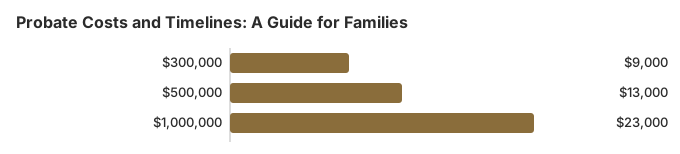
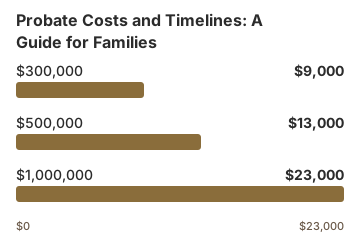
Because the base ignores debt, a $500,000 house with a $400,000 mortgage still produces a $13,000 attorney fee. Our arithmetic is from the statute; it excludes court costs and any "extraordinary" fees a court may approve.
Small-Estate Shortcuts
Most states offer a simplified process for smaller estates. In California, for deaths on or after April 1, 2025, personal property up to $208,850 can generally be collected with a small-estate affidavit instead of full probate (Judicial Council of California). Other states' limits and rules differ; your county probate court's self-help page is the best place to check.
The Rocket Lawyer link in this section is an affiliate link and may earn us a commission; it does not change what you pay. How this works.
For a quick answer on a filing question without retaining a probate lawyer, an executor can use Rocket Lawyer. Its memberships include a set number of written questions to an attorney, answered within one business day, after a free 7-day trial. Rocket Lawyer says it is not a law firm, so hire local counsel if the estate is contested.
What Probate Actually Bills, with One State's Statute as the Example
Probate is the court process that retitles property that did not already pass by beneficiary form, joint ownership, or a trust. The probate cost guide is not a national fee schedule. States do this differently, and several do not use a percentage at all. Where we cite a number below, it is California's statute, not a U.S. average.
California's Published Schedule, and Only California's
California Probate Code section 10810 sets ordinary attorney fees, and section 10800 sets the personal representative's ordinary commission, on the value of the estate accounted for. Both use the same steps: 4 percent of the first $100,000, 3 percent of the next $100,000, 2 percent of the next $800,000, 1 percent of the next $9 million, and one-half of 1 percent of the next $15 million. Above $25 million the court sets a reasonable amount. Extraordinary work, such as a lawsuit or a real-estate sale, can be awarded on top. The text is on the California Legislative Information site. If the person did not live in California, do not use this table. Ask that state's court or a lawyer there.
The Steps, in the Order Families Meet Them
- File the death certificate and, if there is a will, lodge it with the court in the county where the person lived.
- The court appoints a personal representative. Until then, banks will often freeze solely owned accounts.
- Publish notice to creditors and wait out the creditor period that state's code requires. The length is not the same everywhere.
- Inventory the assets. Anything with a beneficiary form usually stays out of this list.
- Pay allowed claims. Reasonable funeral bills are often a priority claim, but the dollar cap and the paperwork differ by state. Ask the clerk before you assume the estate must pay a particular invoice in full.
- Account to the court and distribute what remains.
A small-estate affidavit can skip much of this when the probate estate is under the state's dollar limit. That limit is statutory and it changes. Look it up for the state of residence. Do not use a limit you remember from another state.
How Funeral Medians Fit the Probate Bill
The funeral invoice is often the first large bill. For a planning number before you have a General Price List, the NFDA 2023 study (latest available) reports a median of $8,300 for a viewing and burial, not including the vault or cemetery, and $6,280 for a viewing and cremation. Immediate burial medians in that study are $2,995 if the family supplies the container and $3,720 if the funeral home does. Social Security's one-time death payment is $255 to an eligible spouse or eligible child, claimed on Form SSA-8. It will not pay the funeral. Our zero-budget guide covers what to do when the estate has no cash yet, which is a different problem from the probate fee itself.
Ways Families Shorten Probate Without a Gimmick
Beneficiary designations, joint title with right of survivorship, and payable-on-death accounts never enter the probate estate. A living trust can do the same for assets you actually retitle into it. A trust that was signed but never funded does nothing. Those tools have their own costs and their own failure modes, which is why the estate-planning cost guide treats a trust as optional. Probate avoidance is not the same thing as tax avoidance. The federal estate tax exclusion is an IRS figure, discussed on that page, and it is unrelated to the court fee.
Sources for this section, checked October 22, 2026: California Probate Code § 10810; NFDA 2023 GPL release; SSA Form SSA-8. Educational only. Confirm the forms, fees, and eligibility discussed on Probate Costs and Timelines: A Guide for Families with the agency or a licensed professional.
Frequently Asked Questions
How much does probate cost?
It depends on the state, the attorney's fee arrangement, and which assets must go through probate. In California, statutory attorney fees on a $500,000 estate come to $13,000, and the executor may claim the same amount, before court costs.
Does a mortgage reduce California probate fees?
No. California's statutory fee base is the appraised value of estate property without subtracting mortgages or other debts (Cal. Prob. Code § 10810; Alameda County Superior Court). Take an estate whose only asset is a $750,000 house with a $500,000 mortgage: the fee base is $750,000, so the attorney's statutory fee is $18,000 (4,000 + 3,000 + 11,000), and the personal representative may claim another $18,000 under § 10800.
If the fee were figured on the $250,000 of equity instead, each fee would be $8,000 (4,000 + 3,000 + 1,000). The gap matters most for a heavily mortgaged home; a house retitled into a funded living trust stays out of the probate estate, as described above. A personal representative can also negotiate a lower fee than the statutory amount.
Can I avoid probate?
Assets with named beneficiaries, assets in a living trust, and jointly owned property with survivorship rights usually pass outside probate. Small estates may qualify for simplified procedures.
Sources
- California Probate Code §10810
- Alameda County Superior Court: Closing and distributing the estate
- Judicial Council of California: Summary succession amounts
Sources checked October 21, 2026. This is general information, not legal or tax advice; probate procedures and fees are set by each state, so confirm them with the probate court or an attorney licensed in that state.