Buddhist Funeral Costs: Traditions and Pricing in 2026
Buddhist Funeral Requirements and Traditions
Buddhist funerals differ widely between Theravada, Mahayana, Tibetan and Zen communities, and between the Thai, Vietnamese, Chinese, Japanese and convert sanghas that practice them. The customs below are the ones that most often change what a family pays:
- Both cremation and burial are accepted; cremation is more traditional
- Ceremonies typically include chanting of sutras and meditation
- A monk or nun typically leads the funeral service
- The body may be displayed for viewing before cremation or burial
- A memorial altar with a photo, candles, incense, and flowers is traditional
- Memorial services may be held at intervals (7 days, 49 days, 100 days)
The $3,000 to $12,000 Buddhist estimate is our planning bracket. It is not a government statistic, and it is not one of the medians in NFDA's 2023 General Price List Study, the latest edition, which NFDA's statistics page was still citing in its September 29, 2025 update. No temple price survey is cited for the Buddhist total. The Buddhist bracket starts near the NFDA direct-cremation medians of $2,645 and $2,750 and can pass the $6,280 median for a funeral with viewing and cremation, because this Buddhist page also prices a burial-style service and memorial ceremonies across 49 days. We print the same $3,000 to $12,000 figure on the religion overview. Summing the rows below gives a different number, since the facility and service lines overlap and few families use all of them; each cell is an estimate rather than a surveyed price. Last reviewed October 24, 2026.
Buddhist Funeral Cost Breakdown
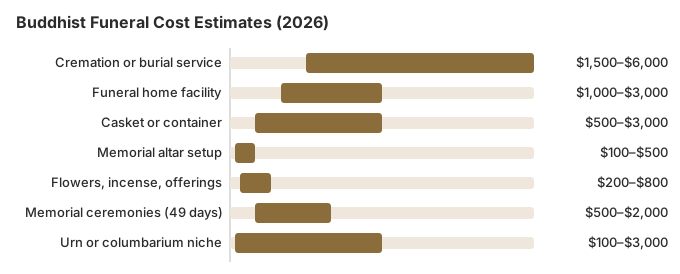
Each row below is a typical price range for one part of a Buddhist service; cremation versus burial and the number of memorial gatherings move the total most. The main differences come from cremation or burial, the length of the viewing, and how many memorial services the family holds at 7, 49 and 100 days.
| Item | Typical Cost Range |
|---|---|
| Monk / temple services | $200 – $1,000 (often by donation) |
| Cremation or burial service | $1,500 – $6,000 |
| Funeral home facility | $1,000 – $3,000 |
| Casket or container | $500 – $3,000 |
| Memorial altar setup | $100 – $500 |
| Flowers, incense, offerings | $200 – $800 |
| Memorial ceremonies (49 days) | $500 – $2,000 |
| Urn or columbarium niche | $100 – $3,000 |
Ways to Save on a Buddhist Funeral
For lower-cost choices outside the temple, see affordable funeral options, and for outside money see payment assistance programs. Ask each funeral home for its General Price List and compare the viewing, cremation and facility-use lines, since chanting may happen during a viewing.
Trusted Support Resources
- Funeral Consumers AllianceIndependent nonprofit: consumer rights and local affiliates
- FTC Funeral RuleFederal protections for funeral consumers
- Your Consumer Rights GuidePlain-English walkthrough of the FTC Funeral Rule
- Financial Assistance ProgramsGovernment and nonprofit programs that may help
- Grief Support ResourcesCurated grief support organizations and hotlines
Frequently Asked Questions
How much does a Buddhist funeral cost?
Most Buddhist services land between $3,000 and $12,000, with cremation, temple offerings and the number of memorial days making most of the difference. Buddhist funerals can be relatively affordable when held at a temple rather than a funeral home.
Does the Buddhist tradition require burial or cremation?
Buddhist funerals vary significantly by tradition (Theravada, Mahayana, Tibetan, Zen) and cultural background. Most Buddhist traditions accept both cremation and burial, though cremation is more common, following the tradition that the Buddha himself was cremated. The requirements section above covers chanting, the role of the monk or nun and memorial services at 7, 49 and 100 days.
How can I save on a Buddhist funeral?
Many temples offer funeral services by donation rather than fixed fees. The emphasis on simplicity in many Buddhist traditions naturally reduces costs. Community support through the sangha (Buddhist community) often includes donated food and volunteer services during the mourning period.
Are there financial assistance programs for Buddhist funerals?
Help usually starts at the temple or sangha. A local temple or sangha can say which funeral homes it works with and whether monks or teachers expect an offering for leading services. Outside the temple, Social Security's $255 lump-sum death payment, VA burial benefits and Medicaid-linked burial aid in some states are open to Buddhist families on the same terms as anyone else; the payment assistance guide lists them.
What makes a Buddhist funeral different from a secular funeral?
The service is usually led by monks, nuns or lay teachers from the family's temple, and it centers on chanting of sutras, a shrine with an image of the Buddha, incense, flowers and offerings, rather than eulogies alone. Many families keep the body for a period of prayer before cremation, and some traditions hold further memorial gatherings on set days afterward, such as the 49th day in many Mahayana and Tibetan communities.
Practices vary a lot between Theravada, Mahayana, Tibetan and Zen communities and between cultures, so ask the temple what it expects before booking the funeral home. Temple ceremonies are often given for a donation rather than a fixed fee, which you can budget separately from the funeral home's bill.