Burial Costs in Hawaii (2026)
Hawaii is by our estimate among the costliest places to bury someone: $25,250 to $29,750 with the cemetery's charges, including an $11,000 funeral service and a $5,500 plot. Hawaii also has unusually broad rules for disturbing a grave, a state program that pays toward cremation but not a plot, and veterans cemeteries on every major island. This page covers the costs, those rules, and burial at sea as an alternative many families weigh.
What a Hawaii Burial Costs
| Item | Hawaii figure | Low to high |
|---|---|---|
| Funeral service | $11,000 | $8,250 – $14,300 |
| Cemetery plot | $5,500 | $2,750 – $11,000 |
| Casket | $3,300 | $1,100 – $8,800 |
| Burial vault / liner | $2,200 | $800 – $10,000 |
| Opening & closing grave | $2,750 | $500 – $3,000 |
| Headstone / marker | $1,500 | $500 – $5,000+ |
| Embalming | $1,100 | $500 – $1,500 |
About the Hawaii estimates: they are our estimates, not a survey of Hawaii mortuaries or cemeteries, so check real quotes against them; they are not a quote or professional advice. Read our method and the disclaimer.
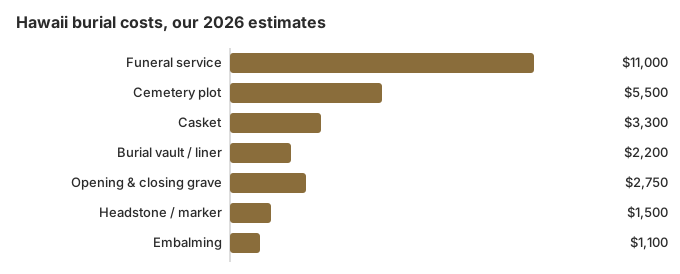
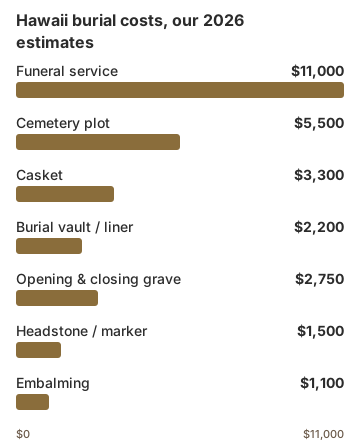
With the cemetery fees, we put a Hawaii burial at $25,250 to $29,750; the casket and headstone account for most of the spread.
Bringing down a Hawaii Burial Bill
Burial at Sea and Other Hawaii Choices
Ocean burial is governed by the EPA's general permit under 40 CFR 229.1, and scattering on land needs the landowner's permission. Many Hawaii families who choose cremation keep or scatter the ashes rather than buying a plot, and the National Memorial Cemetery of the Pacific in Honolulu accepts cremated remains of eligible veterans. For a full-body burial at sea, the EPA rule requires the body to be prepared so it sinks quickly and permanently, and only flowers and wreaths that break down may go overboard with it. The family or the captain must report the burial to the EPA regional office within 30 days. The U.S. Navy also commits the remains of eligible veterans to the sea from its ships at no charge, though families cannot attend those services.
Burial Resources
- Funeral Consumers AllianceNonprofit consumer advocacy for funeral pricing
- Best Burial InsuranceCompare plans to cover burial expenses
- Green Burial OptionsEco-friendly and natural alternatives
- Headstone & Monument GuideCosts, types, and buying tips
- Best Online Casket RetailersCaskets bought online often cost less
Compare Funeral Costs
- Cremation vs. Burial Cost ComparisonSide-by-side price comparison to help you decide
- Direct Cremation: Most Affordable OptionNFDA 2023 median $2,645 with a family-supplied container (latest available)
- Cheapest Funeral OptionsLower-cost alternatives, with typical price ranges
- How to Compare Funeral PricesStep-by-step guide to comparing funeral prices
- Funeral Cost BreakdownEvery line item explained: know what you're paying for
- Average Funeral Cost in 2026National cost breakdown with real prices
Hawaii Burial Choices, from a Simple Grave to a Mausoleum
Ways to pay less in Hawaii:
- Ask each cemetery for written prices. Cemeteries sit outside the FTC Funeral Rule, so request the plot, container, opening and perpetual care charges and check them against our estimates of $5,500, $2,200 and $2,750.
- Ask about burial without a vault. Some cemeteries may allow a plain container or no outer container; ask before you buy one. If an outer container is required, ask whether a plain liner meets the rule, and get the price of each from both the cemetery and the funeral home before choosing.
- Weigh burial at sea. Federal rules allow burial of a body at sea at least three nautical miles from land and 600 feet deep, and cremated remains at least three nautical miles out, with notice to the EPA within 30 days (40 CFR 229.1).
- Price cremation as well. About 70% of Hawaii deaths end in cremation by our estimate, and asking for both prices shows how much of the burial bill is the cemetery.
- Weigh the $3,300 Hawaii casket estimate against the casket buying guide and the list of online casket retailers; a funeral home cannot charge a fee for a casket you bring, though shipping one to the islands adds cost.
- Price the marker separately. Ask the cemetery what markers it allows, then get a monument dealer's quote to compare.
For ways to bring a Hawaii burial bill down, see our affordable funeral options guide or payment assistance programs.
When Hawaii Requires a Disinterment Permit
Hawaii's rule is wider than most. A Department of Health disinterment permit is needed for almost any disturbance of a grave. That includes reburying the remains in the same spot, adding another burial (even cremated remains) to an existing grave, and moving remains temporarily to repair a cemetery (HAR ch. 11-118; checked October 29, 2026).
- Applying: families cannot apply on their own. A registered mortuary or cemetery files online for them, and an owner of a family burial plot does not count as a cemetery. Every survivor with equal or higher priority must consent in writing.
- Moving the remains: a disinterred body cannot be transported, on-island or out of state, until the disinterment permit is issued and a burial-transit permit follows.
- Old burial sites: prehistoric and historic burial sites fall under the Department of Land and Natural Resources instead.
A First Hawaii Death Certificate Is $10; Extras Are $4
To move a Hawaii cemetery plot or an estate claim, you will usually need a certified death certificate for each office. The Hawaii Department of Health charges $10 for the first certified copy and $4 for each additional copy of the same certificate ordered at the same time. There is also a $2.50 fee on every order of up to five certificates, and another $2.50 for each additional group of five (Hawaii Vital Records, death certificates; checked November 12, 2026). Certified copies go only to a person with a direct and tangible interest in the record, such as a spouse, parent, descendant, sibling, personal representative, or someone who needs the record for a court order, a joint-tenancy title or a credit-insurance claim.
- Order extras in the same request; at $4 each they are much cheaper than starting over at $10.
- Budget the $2.50 order fee, which applies even to a single copy.
- Neighbor-island families can start with the local District Health Office rather than mailing every request to Honolulu.
Who Regulates Burial in Hawaii, and What Help Exists
Hawaii's Department of Commerce and Consumer Affairs licenses both cemeteries and prepaid funeral plan sellers, so one agency covers a license question about either. Its Regulated Industries Complaints Office investigates complaints. A family does not need a funeral director for a Hawaii burial and can settle the plot, the opening and the container with the cemetery directly.
A burial still needs a disposition permit. Cremation has no fixed waiting period, but a health-department permit cannot be issued until a death certificate is filed (HRS §§ 338-23, 338-25).
State Assistance
Hawaii's program does not pay for a plot. An unclaimed body is cremated with up to $1,600 paid to the provider, and the family of an eligible assistance recipient can apply within 60 days for a lump sum equal to Social Security's (Haw. Rev. Stat. § 346-15; HAR ch. 17-1745). Social Security's own death payment is $255, and only a qualifying spouse or child receives it.
Burial at Hawaii State Veterans Cemetery
The National Memorial Cemetery of the Pacific (808-532-3720) takes cremated remains only. The state veterans cemeteries take burials: Hawaii State Veterans Cemetery on Oahu (808-369-3575), Kauai (808-241-4460), Lanai (808-565-7086), East and West Hawaii (808-961-8311), Maui (808-876-4534) and Molokai (808-553-3222). The plot and marker are free for an eligible veteran (VA National Cemetery Administration).
A Short Hawaii Burial Checklist
- Get written prices from two cemeteries and two mortuaries.
- Ask the cemetery whether it requires an outer container.
- If the person received state assistance, apply to DHS within 60 days.
- For a veteran, call the island's state veterans cemetery first.
- Report a misleading cemetery or pre-need seller to 808-586-2670.
If you are buying a plot for a veteran in Hawaii, ask first about a no-cost gravesite in a national or state veterans cemetery, and about the VA plot or interment allowance if you still use a private Hawaii cemetery. The current figures and who may file are on our VA burial and plot benefits page.
Frequently Asked Questions
What is the price of a Hawaii burial?
Our Hawaii estimate is $25,250 to $29,750: an $11,000 funeral service, a $5,500 plot, a $2,200 vault, $2,750 for opening and closing, a $3,300 casket and a $500 to $5,000 headstone.
Must a Hawaii grave have a vault?
Any requirement comes from the cemetery, so ask it what it accepts. A liner usually costs less than the $2,200 vault we estimate; vaults run from $800 to $10,000.
What is the cheapest burial in Hawaii?
On a Hawaii price list the cheapest burial is normally direct burial, which leaves out embalming, a viewing and a service. Burial at sea or cremation can cost less again, since neither needs a plot.
How should I compare Hawaii cemeteries?
Ask at least two cemeteries for an itemized sheet covering the plot, the opening and closing, the container rule and perpetual care, and note that adding a later burial to an existing grave needs a Department of Health disinterment permit.
What does a Hawaii burial total?
Service $11,000, plot $5,500, casket $3,300, vault $2,200, opening $2,750 and headstone $500 to $5,000: $25,250 to $29,750 before cash advance items.
Is natural burial possible in Hawaii?
Whether a natural burial is possible depends on the cemetery: ask if it will take an unembalmed body in a biodegradable container with no vault; our green burial guide lists what to ask.