Cremation Costs in North Carolina (2026)
North Carolina treats cremation as its own licensed trade: under the North Carolina Crematory Act, every crematory needs a license from the Board of Funeral Service, a crematory manager and at least one full-time technician with a board-approved training certificate. A family’s side of that law is shorter. It covers who signs, a 24-hour minimum after death, and what happens to ashes nobody collects. This site estimates a direct cremation in North Carolina at about $1,700 and a cremation with a full service at about $5,600, with roughly 48% of deaths in the state ending in cremation.
North Carolina Crematories Must Be Board-Licensed (G.S. 90-210.123)
Direct Cremation
- The body goes to a crematory licensed by the North Carolina Board of Funeral Service, not to an unlicensed facility (G.S. 90-210.123)
- No crematory may require a casket, or refuse a body that arrives without one (G.S. 90-210.128)
- The container must be combustible, closed, rigid and labeled with the name, date of death, sex and age of the person who died
- You are not required to buy an urn; the ashes can come back in an initial container (G.S. 90-210.128)
- A memorial can follow on any date, since the ashes can be held for you
Cremation with Service
- A viewing and funeral first, then cremation once 24 hours have passed since death
- The authorizing agent signs the cremation form, and so does a licensed funeral director (G.S. 90-210.125)
- Often uses a rental or cremation casket for the service
- Usually includes a basic urn
- About $3,900 more than direct cremation on this site’s North Carolina figures
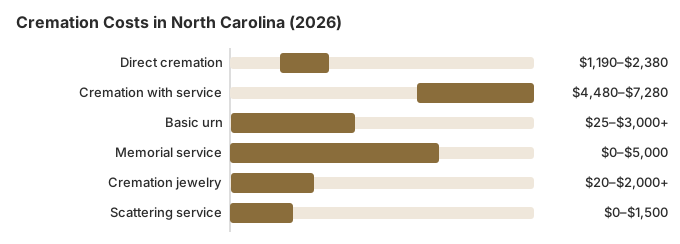
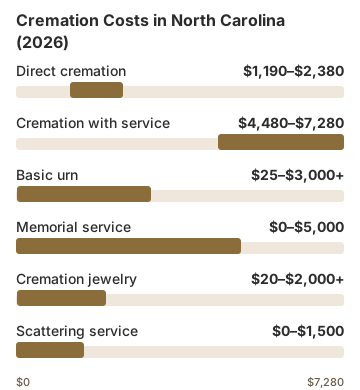
What Each Part of a North Carolina Cremation Costs
| Item | Average Cost | Range |
|---|---|---|
| Direct cremation | $1,700 | $1,190 – $2,380 |
| Cremation with service | $5,600 | $4,480 – $7,280 |
| Basic urn | $50 – $300 | $25 – $3,000+ |
| Memorial service | $500 – $2,000 | $0 – $5,000 |
| Cremation jewelry | $50 – $500 | $20 – $2,000+ |
| Scattering service | $200 – $600 | $0 – $1,500 |
Methodology note: These figures are our estimates, not a survey of local providers, and they are not a quote or professional advice. See how we calculate them or read the full disclaimer.
State sources: statute; North Carolina Board of Funeral Service; N.C. Gen. Stat. § 130A-415.
What a North Carolina Crematory Must Do
The 24-hour minimum in G.S. 90-210.129(e) has one exception: when death came from an infectious, contagious or communicable disease on the Commission for Public Health’s list, the medical examiner, county health director or attending physician can waive the wait in writing. For a death in another state, a North Carolina crematory needs that state’s burial-transit or disposal permit before it can cremate.
North Carolina forbids cremating more than one person in a chamber at the same time. The only exceptions, and only on the agent’s written direction, are the remains of multiple fetuses or of babies up to one year old from the same mother and the same birth (G.S. 90-210.129(h)). If the ashes do not fit in the container or urn, the extra must come back to the family in a separate container rather than be discarded.
When the cremation is finished, the crematory issues a certificate of cremation naming the person, the date and the crematory, signed by the manager (G.S. 90-210.127). Receipts are signed both when the body arrives and when the ashes leave, and the crematory keeps them for three years. Shipped ashes must go by a method with tracking and a signed delivery receipt unless the agent agrees in writing to something else.
Crematories that sell at-need cremation goods and services to the public must follow the FTC Funeral Rule (G.S. 90-210.123(d1)), and a cremation society tied to a North Carolina crematory must register its name with the Board (G.S. 90-210.135). For violations, the Board can suspend or revoke a license or accept a penalty of up to $5,000.
A North Carolina crematory must also have a named crematory manager, and it must employ at least one full-time crematory technician who has finished a training course approved by the Board. The Board recognizes the Cremation Association of North America certificate for that purpose (G.S. 90-210.121(14), 90-210.123(d)). Applicants for a crematory license go through a state and national criminal history check. The Board inspects the premises before it issues the license, and the license has to be renewed every December (G.S. 90-210.123(c), (c1), (e)). If you want to check a crematory before you sign, the Board can tell you whether its license is current.
Who Signs, and What the North Carolina Form Asks
The North Carolina Crematory Act says a crematory may not cremate until it receives a cremation authorization form signed by the authorizing agent, the person entitled to arrange disposition under G.S. 130A-420 (G.S. 90-210.125). The form is prescribed by the Board of Funeral Service, and a crematory may use its own version only if the Board has approved it.
The form asks the agent to confirm the identity of the person who died, give the time and date of death, and state that no living person has a higher right to decide, or that the agent tried and could not reach that person and has no reason to think they would object. The agent must also either disclose where every living person with an equal right can be found or state that they do not know. It records who may receive the ashes and how they will finally be placed, if that is known, and the agent warrants that the body holds no pacemaker or defibrillator not approved for cremation.
Those statements are not a formality. An agent who signs is treated as warranting the facts on the form and is personally liable for damages that result (G.S. 90-210.125(b)). A licensed funeral director signs too, and is answerable for the identification, the date and time of death, the funeral home and crematory names, and the implant statement.
A signature can still be taken back. Until the cremation starts, the agent may revoke the authorization in writing and tell the crematory to release the body to another crematory or funeral home, and the crematory must follow those instructions (G.S. 90-210.125(d)).
North Carolina Requires Medical Examiner Authorization
In North Carolina the cremation form carries legal promises from the family, so read it, and ask about these points, before you sign:
- Read the General Price List line for direct cremation and see whether it includes the medical examiner’s cremation clearance and the 24-hour hold. North Carolina will not let a body be cremated until a medical examiner has authorized it (G.S. 90-210.129 and 130A-388), and some homes list that step as a separate fee.
- No casket is required, and the crematory cannot require an urn either (G.S. 90-210.128). The body only needs a rigid, combustible container that closes and is labeled with the name, date of death, sex and age (G.S. 90-210.121(9)). Plain wood or heavy cardboard meets that standard.
- Fill in the part of the form that says what should happen to the ashes. If nobody collects them, the crematory can dispose of them 30 days after sending notice by certified mail (G.S. 90-210.130).
Lowering a North Carolina Cremation Bill Without Skipping the Basics
In North Carolina the cremation itself is a small part of the bill; what you add around it drives the price:
- When you compare prices, ask which licensed crematory each funeral home uses. The North Carolina Board of Funeral Service licenses every crematory and inspects them, and it can tell you whether a crematory’s license is current.
- Check cremation societies: In North Carolina a cremation society is a group affiliated with a licensed crematory, and a crematory has to register the society's name with the Board of Funeral Service before running one (G.S. 90-210.121(10a), 90-210.135). Ask for the society's price list next to the funeral home's. Then check with the Board that both the society and its crematory are on file.
The Regional Picture Around North Carolina Cremation Prices
At about 48%, North Carolina’s estimated cremation rate is close to its neighbors’. It is a little above Tennessee (42%) and Georgia and South Carolina (45%), and below Virginia (50%). Its $1,700 direct cremation estimate is in the same narrow band, from South Carolina and Tennessee at $1,600 to Virginia at $1,900. Choosing cremation over a full burial in North Carolina usually saves $5,400 or more.
Cremation Resources
- Cremation vs. Burial CostsSide-by-side cost comparison
- Final Expense InsuranceCoverage options to help pay for cremation costs
- Pet Cremation CostsOptions and prices for pet cremation and memorials
- Cremation Jewelry GuideMemorial keepsakes and remembrance options
- Funeral Consumers AllianceNonprofit advocacy: compare cremation providers
Compare Funeral Costs
- Cremation vs. Burial Cost ComparisonSide-by-side price comparison to help you decide
- Cheapest Funeral OptionsLower-cost alternatives, with typical price ranges
- How to Compare Funeral PricesStep-by-step guide to comparing funeral prices
- Funeral Cost BreakdownEvery line item explained: know what you're paying for
- Direct Cremation: Most Affordable OptionNFDA 2023 median $2,645 with a family-supplied container (latest available)
- Average Funeral Cost in 2026National cost breakdown with real prices
Planning Your Own Cremation Ahead in North Carolina
A North Carolina resident can sign a cremation authorization form for their own cremation in advance, with two witnesses as G.S. 130A-420 requires, and keep a copy while sending another to the funeral home or crematory (G.S. 90-210.126). The preneed form includes a choice about the family. You can tick a box saying no survivor may cancel the cremation, or one that lets only the survivors you name cancel it and choose other arrangements.
When a crematory holds a completed preneed form and has the body, the statute says it must carry out the cremation and the disposition instructions on that form. You can cancel a preneed authorization at any time before death by destroying the form and giving written notice to whoever received a copy. A preneed contract sold by a funeral home that includes cremation has to state where the ashes will go.
This site may earn a commission from the Cremation Club link below, and it costs you nothing extra. How this works.
The authorization form settles who decides, not what it will cost. Cremation Club, a membership company with an office in Raleigh, lists a guaranteed $1,250 cremation on its entry plan, available as soon as you join. If you sign up, keep the membership papers with your signed authorization so your family can find both.
Paperwork to Expect Back from a North Carolina Crematory
When a North Carolina cremation is finished, the crematory manager issues a certificate of cremation (G.S. 90-210.127(e)). It shows the name of the person who died, the date of the cremation, and the crematory’s name and address, and the manager signs it (G.S. 90-210.121(5)). Keep it with the death certificates. Cemeteries, columbaria and some airlines ask for it.
There are receipts at both ends. When the body arrives, the crematory and the person delivering it both sign a receipt. When the ashes are released, the crematory’s representative and the person receiving them sign a receipt with the date, time and place. That second receipt includes a statement that the ashes will be handled properly (G.S. 90-210.127, 90-210.130(e)). The crematory keeps copies for three years. After the handoff, you can carry the ashes anywhere in North Carolina without a permit.
You can change your mind after signing the form, but only before the cremation starts. Send written instructions to cancel, and the crematory has to release the body to another crematory or funeral home (G.S. 90-210.125(d)). If the person died in another state, the crematory needs that state’s burial-transit or disposal permit first (G.S. 90-210.129(c1)). If a pacemaker or defibrillator is not approved for cremation, the authorizing agent must make sure it is removed (G.S. 90-210.129(d)). Tell the funeral home on the form and it takes over that step.
Ashes, Disputes and Alkaline Hydrolysis
If the form names no grave, crypt, niche or scattering area, it must tell the family that the crematory will hold the ashes for 30 days unless they are collected sooner (G.S. 90-210.125). After that, if the ashes are still unclaimed 30 days after a certified letter to the agent’s last known address, the crematory may release them to another family member, which matters when the agent has moved or stopped answering.
Scattering can be done by boat or by airplane, and ashes may not be mixed with another person’s except at sea, by air or in a cemetery scattering area, unless the agent agrees in writing. Members of one family can share a container designed for more than one person if the family consents in writing. When relatives disagree about who gets the ashes, the crematory may hold them until the dispute is resolved or a court orders a release, and it may charge a reasonable storage fee once the dispute is more than 30 days old (G.S. 90-210.131).
North Carolina also licenses alkaline hydrolysis, a water-based alternative to flame cremation. It may be performed only on the premises of a funeral establishment with a valid permit, it follows the same paperwork and fee rules as cremation, and unless the equipment maker says otherwise a pacemaker or defibrillator does not have to be removed first (G.S. 90-210.136).
Notes on Raleigh and the Rest of North Carolina
Even when the disposition is a cremation, insurers, banks and often the crematory's release desk still ask for a certified death certificate. You can order from the county Register of Deeds where the death occurred, which can often issue copies the same day, or from NC Vital Records in Raleigh. The state charges a $24 search fee for each three-year period, or portion of one, and that fee includes one certified copy if the record is found. It is not refunded if the search turns up nothing. Each additional copy of the same record ordered at the same time is $15. Ordering online through VitalChek adds a $13.95 processing fee, and expedited in-person service, by appointment, is $15 more (NC Vital Records fees; checked November 12, 2026).
- Start with the Register of Deeds in the county of death; it is usually faster than a state mail order.
- If you are unsure of the year, remember that each extra three-year search is another $24.
- Ask the funeral home what it charges per copy before you add those copies to the cremation contract.
North Carolina's $50 Cap on the Cremation Certification
Under G.S. 130A-388(b) (checked October 29, 2026), no body can be cremated in North Carolina until a medical examiner certifies that the cause and manner of death have been looked into and nothing more is needed. The examiner may charge the applicant for that certification, but the fee is capped at $50.
The statute exempts deaths less than 24 hours after birth and deaths from natural disease in a licensed hospital, unless the death otherwise falls under the medical examiner's jurisdiction.
What North Carolina Requires: a 24-hour Pause Before Cremation
A North Carolina cremation cannot start within 24 hours of death. Before the crematory proceeds, a medical examiner must certify that no further examination is needed (N.C.G.S. 90-210.129, 130A-388). The same statute gives relatives and their invitees access to the crematory area, subject to the crematory's safety rules, and it requires remains to be kept at 40 degrees Fahrenheit or colder unless the cremation will begin within 24 hours of the crematory taking custody. The crematory will also want the death certificate, the cremation permit and a signed authorization from the next of kin.
Crematories and the funeral homes that sell cremation are licensed by the North Carolina Board of Funeral Service. A family does not have to hire a director for every step, but the crematory will not skip that paperwork.
A North Carolina county DSS director arranges cremation or hydrolysis of an unclaimed body, paid by the estate first and then by the county where the person lived (N.C. Gen. Stat. § 130A-415). (Source: N.C. Gen. Stat. § 130A-415.) Social Security's $255 lump sum is paid only to an eligible North Carolina spouse or child, and only if claimed within two years of the death.
Choosing cremation does not give up a North Carolina veteran's cemetery benefit; urns can be interred in national cemeteries free of charge. Options in North Carolina include Salisbury National Cemetery Annex (704-636-2661), Coastal Carolina State Veterans Cemetery (910-347-4550), and Eastern Carolina State Veterans Cemetery (919-648-0510). See cem.va.gov.
Build North Carolina's 24-Hour Wait Into Travel and Memorial Plans
- Ask North Carolina cremation providers to itemize transport, the container and the crematory fee before you choose one.
- Build the 24-hour wait set by N.C.G.S. 90-210.129, 130A-388 into any North Carolina travel or memorial plans.
- Ask the North Carolina DSS director whether the county uses cremation or hydrolysis for unclaimed bodies.
- A cremation provider that misstates its prices can be reported at 919-733-9380.
If you are planning a cremation in North Carolina for a veteran, VA.gov treats cremation, burial at sea, and donation to a medical school as qualifying burial types. Our whether the VA pays for cremation page walks through the allowance, the national-cemetery inurnment option, and how a North Carolina family applies.
Frequently Asked Questions
What does cremation cost in North Carolina in 2026?
Expect about $1,700 for a direct cremation in North Carolina and about $5,600 if a viewing and funeral come first, on this site’s estimates. Before you compare totals, check whether each quote includes the medical examiner’s clearance, the certified death certificates and the container for the ashes.
Which cremation options exist in North Carolina?
In North Carolina the main choice is between two options. One is direct cremation, about $1,700, where the body goes straight to the crematory once the medical examiner clears it. The other is a full service first. Traditional cremation at $5,600 adds a full funeral home service before the cremation, $3,900 more than the direct tier in North Carolina. A memorial service after the cremation falls between the two in price.
What are North Carolina's cremation regulations?
North Carolina’s Crematory Act (G.S. 90-210.120 onward) sets the 24-hour wait, the authorization form and the medical examiner clearance. It also requires crematories to keep receipts and records for three years, and it forbids cremating two people in one chamber at the same time, with narrow exceptions for infants of the same birth. The Board of Funeral Service licenses crematories. The cremation rules and help section lower on this page has the citation and complaint contacts.
Is ash scattering legal in North Carolina?
Yes. G.S. 90-210.130 allows cremated remains to be scattered over uninhabited public land, a public waterway or the sea, subject to health and environmental standards, or on private property with the owner's consent; if the crematory does the scattering, that consent must be in writing. The remains must be removed from their container first.
If a family does not collect the remains, the crematory may dispose of them 30 days after sending notice by certified mail. Blue Ridge Parkway and other park units require a permit under 36 CFR 2.62. The North Carolina Board of Funeral Service (919-733-9380) licenses crematories.
Why do so many North Carolina families choose cremation?
Many don’t yet. This guide estimates North Carolina’s rate at about 48%, below the 63.4% national figure NFDA projected for 2025, so burial is still common here. For families who do choose cremation, price is a big part of it: the gap between direct cremation and a traditional funeral is about $5,400 in North Carolina. State law also lets people sign their own cremation form in advance, with two witnesses, so the family does not have to make that decision for them.
How long does cremation take in North Carolina?
Two steps usually set the pace in North Carolina, and neither is the cremation itself, which takes two to three hours. State law does not allow cremation in the first 24 hours after death. The medical examiner also has to authorize the cremation. If the death was from a dangerous communicable disease, the medical examiner, county health director or attending physician can waive the 24-hour wait in writing.
Do I have to skip the service if I choose cremation in North Carolina?
No. North Carolina families who want a viewing first pay about $5,600 by our estimate (typically $4,480 to $7,280), because the funeral home holds and prepares the body and runs the service before cremation. Leaving all of that out is direct cremation, about $1,700 here (usually $1,190 to $2,380).
North Carolina bars cremation within 24 hours after death and needs a medical examiner's clearance (N.C.G.S. 90-210.129), so a visitation on the first day fits within the legal timeline. A memorial with the urn present later is another lower-cost choice.